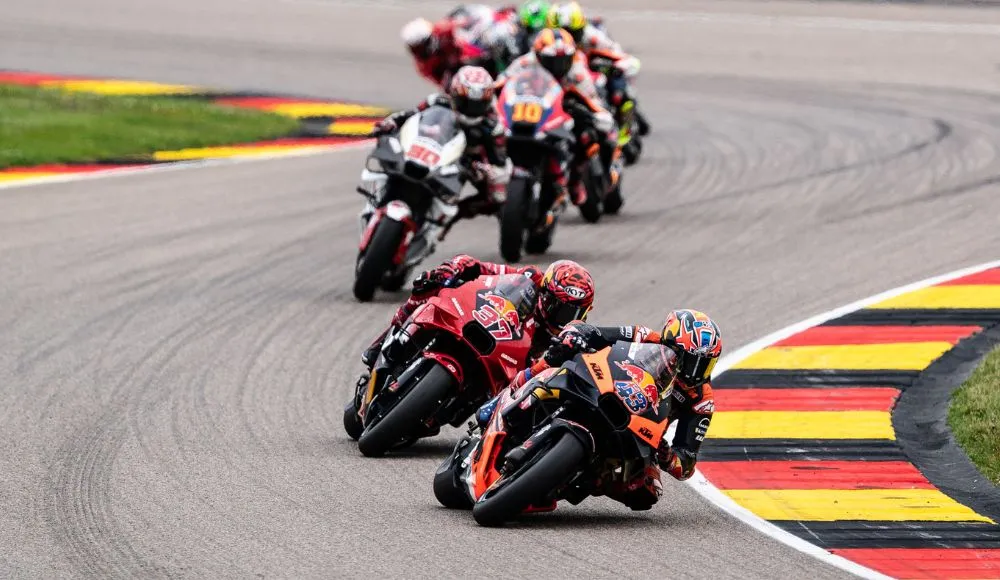
MotoGP German Grand Prix 2026
Motorrad Grand Prix Deutschland - King of the Ring Battle
There are race weekends and then there is the Sachsenring. On 12 July 2026, the Motorrad Grand Prix Deutschland returns to the calendar, bringing with it one of MotoGP’s ultimate tests of raw skill, nerve and mental endurance. As the world championship reaches the high-stakes heart of its European campaign, the margin for error has completely vanished. Every single point on the board matters, and a solitary mistake carries a season-defining price.
The tight, relentless anti-clockwise layout has long held a reputation as a true rider’s circuit. It is an asphalt arena that rewards flawless precision, punishes the slightest hesitation on the throttle, and demands complete, unwavering commitment through every single lap. With thousands of passionate fans filling the grandstands, the pressure to cut through the noise and emerge as the next true "King of the Ring" has never been higher.
The Sachsenring: Where Champions Are Made
The German Grand Prix also lines up as an official MotoGP Sprint weekend, a format choice that completely alters the technical dynamic of the paddock. Teams are handed just one solitary practice session on Friday morning before the qualifying order is decided. This leaves engineers and mechanics with virtually no time to perfect complex bike setups, opening a massive door for surprise results and sudden, dramatic shifts in momentum.
Architecturally, the Sachsenring is entirely unlike any other circuit on the global calendar. Its unique, punishing sequence of left-hand corners places immense structural stress on the left side of the tyres, generating massive thermal degradation as riders search for any shred of rear mechanical grip.
The ultimate test of nerves, however, comes at the blind, downhill plunge through Turn 11. Famously known as "The Waterfall," it stands out as one of the most intimidating corners in all of motorsport - a place where a microscopic front-end slide or a sudden low-side wash can instantly end a rider's weekend in the gravel.
The Championship Landscape: Dethroning the Ring Master
When analyzing the history of the Sachsenring, one name naturally benchmarks the entire field: Marc Márquez. His extraordinary track record at this venue has made him the gold standard and every single rival arrives in Germany knowing that the road to victory runs directly through him on his strongest circuit.
However, the 2026 title fight has reached a massive boiling point, leaving the championship wide open as riders head into Germany:
Jorge Martín (193 pts): Currently leading the world championship standing after a hard-fought podium at the Dutch GP, Martín has found an elite rhythm on his Aprilia. He rolls into Germany carrying heavy championship expectations and the outright speed necessary to challenge for the top step of the podium.
Marco Bezzecchi (186 pts): Sitting a mere 7 points back from the title lead, Bezzecchi has been a model of consistent aggression. Despite an unfortunate DNF (Did Not Finish) at Assen, his high-apex corner speed makes him an immediate threat.
Fabio Di Giannantonio (177 pts): Anchoring third place in the overall standings, "Diggia" has been the real-time front-runner surprise of the season, consistently exploiting late-braking performance to steal crucial rostrum spots.
Ai Ogura (168 pts): Riding high on waves of momentum, the Trackhouse breakout star arrives fresh off a majestic, maiden premier-class victory at the high-speed Dutch TT.
Marc Márquez (153 pts) & Francesco Bagnaia (130 pts): While Márquez seeks to ignite his signature Sachsenring magic, the master tactician Bagnaia will look to erase a costly retirement in the previous round and turn consistent, methodical laps into crucial championship gains.
South African fans will have their eyes firmly fixed on Brad Binder (60 pts), who continues to fly the flag with his trademark aggressive riding style and tire-smoking backing-it-in entry technique. Alongside dynamic threats like Raúl Fernández and Pedro Acosta, Binder possesses the raw pace to completely disrupt the established order the moment track conditions become unpredictable.
Strategy Could Decide Everything
At the Sachsenring, tire management frequently proves far more critical than outright straight-line top speed. The long race distance forces riders into a delicate balancing act, requiring them to nurse left-side tire wear while actively avoiding costly high-side crashes as the rubber compound heat spikes and traction disappears.
Compounding the tire dilemma is the unpredictable nature of the German summer weather. If sudden rain clouds roll over the circuit, the race can instantly transform into a chaotic flag-to-flag battle. Teams must react in a flash, timing strategic bike swaps and mid-race management perfectly to survive the changing elements.
The Final Verdict
Every single lap at the Sachsenring feels like riding on a knife-edge. Between brutal tire degradation, relentless left-hand G-forces, and the constant threat of changing weather, the German Grand Prix promises to write another unforgettable chapter in the 2026 world championship campaign.
Whether you are sitting back at home or tracking the sector times on the go, you never have to miss an active market shift. Experience fast, frictionless betting on the app and secure your bet instantly with 1-click betting